 We (Edith Hope Fine and Judith Josephson) are the Grammar Patrol. Both of us taught for years and are now writers, with thirty plus books between us, including our two popular grammar guides, Nitty-Gritty Grammar and More Nitty-Gritty Grammar. For close to twenty years, we taught writing and grammar basics and now we blog about grammar for writers.
Readers’ attention wanders when your words lack variety.
The key? Vary the form. Vary the length.
Does this ring familiar?
Dick sat down.
Jane played ball.
Spot ran fast.
The repeated noun-verb, three-word form works fine for beginning readers. But if a paragraph you’ve written sounds clunky when read aloud, check for same-length sentences. When doing editing work, we’ve seen paragraphs where each sentence has seven words. It took us a while to figure out why the paragraph didn’t sing even though there was nothing wrong with the writing itself. Excite your readers by changing up sentence length.
The other key? Vary your sentence formations.

When we taught middle school English, we handed out sets of cards in different colors—the noun cards were blue, verbs were green, prepositional phrases were yellow, and so on. We could ask for sentences starting with prepositional phrases and the students would shuffle their cards to create their own unique combinations. This hands-on activity fully engaged the young writers. Much laughter often ensued.
Starting Points:
Noun-Verb
There’s nothing inherently wrong with a subject followed by a verb:
• Esther Williams swam beautifully.
Just check to see if the noun-verb form dominates your page. It’s an easy problem to fix.
Clause
Clauses have both a subject and a predicate. An independent clause can stand alone as a simple sentence:
• Puck leapt off the back of the stage.
Dependent clauses rely on the rest of a sentence to make sense. These clauses have a subject and a predicate, but they don’t form complete sentences and they don’t make sense on their own:
• when Harry met Sally
• because she loves ice skating
• that shone on the mountain
• since we lost the game
• then bounced up using a hidden trampoline
Combine an independent clause with a dependent clause or a dependent clause with an independent clause and you’re in business:
• Puck leapt off the back of the stage, then bounced up using a hidden trampoline.
• Since we lost the game, playoff dreams are doomed.
Phrase
There are five kinds of phrases, but all you need to know is that a phrase lacks a subject/predicate combo and is never a complete sentence.
• raced for class (participial phrase)
• from morning on (prepositional phrase)
• walking the dog (gerund phrase)
• his temporary filling (noun phrase)
• to infinity and beyond (infinitive phrase)
When editing your own work, bear sentence length and form in mind. Aim for variety in your writing to keep your readers interested in what you’re saying.
For more on grammar specifics, consult our zany grammar guides, Nitty-Gritty Grammar: A Not-So-Serious Guide to Clear Communication and More Nitty-Gritty Grammar: Another Not-So-Serious Guide to Clear Communication.
Key image credit: ID 24790186 © Ayzek09 | Dreamstime.com
 Judith Pinkerton Josephson loves to dig into the past. She believes that behind every person, every relationship, there lies a story. Her award-winning biographies, history books, and picture books include fiction and nonfiction for children. She has also written for adults. In this column, she blogs about the reissue of her biography of detective Allan Pinkerton as an ebook.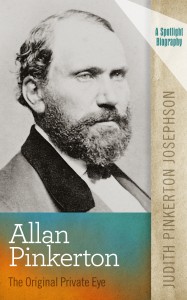
 Richard Fitchen, BA MA MLIS PhD, was a firefighter and National Guardsman before teaching at the University of Washington and the University of California (Berkeley and Santa Barbara). He served as the social sciences bibliographer in Yale University’s Libraries and retired as bibliographer and reference department head at the Stanford University Libraries. He now writes full time and enjoys traveling with family.
 In the first book,
  In the second book,
  Book three,
  The fourth book,
  The fifth and final book,
  Did you really say banish the keys talk? Why yes I did because “Let me talk to my parents about giving up driving,” said no one ever!
 Currently,
 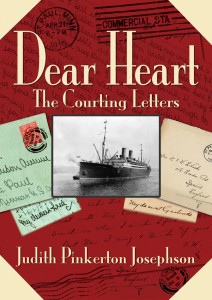 A trip to my mailbox these days might yield bills, ads, and the usual collection of junk mail. The sight of a handwritten letter nestled in the pile delights me. It was not always so. More than a century ago, letters and illustrated postcards were the main ways people communicated, be they friends, relations, or lovers. Phones were an expensive luxury.
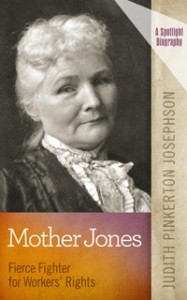 Happy Mother’s Day to all the mothers out there, as well as those who mother and mentor young people—aunts, grandmothers, friends, teachers, youth leaders, coaches! One Mother’s Day, my daughter gave me a paperback book, Important Women of the Twentieth Century. It held a section on Mother Jones, a.k.a. Mary Harris Jones, which inspired me to write one of my most intriguing biographies for young people. For the next several months, Mother Jones figuratively stomped around my office in her long black dress, hat, and boots, looking over my shoulder to make sure I captured her spirit and tenacity.
 Judith Pinkerton Josephson has taught at various grade levels, and has written books for children—biographies, picture books, and childhood history books—and co-written two zany grammar guides for adults. She believes that behind every person and every relationship, there lies a story. Capturing the essence of that story in the space and time it took place makes writing fascinating. Visit her
 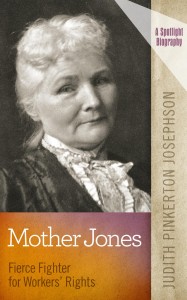 As I was writing my biography of Mary Harris Jones, a.k.a. Mother Jones, I visualized her stomping around my office in her long black dress, hat, and boots, looking over my shoulder to make sure I captured her spirit and tenacity. Every once in a while, her words would hover in the air: “Get it right. I’m not a humanitarian. I’m a hell raiser.” “I was born in revolution.” “I reside wherever there is a good fight against wrong—all over the country. . . . Wherever the workers are fighting the robbers, I go there.” “Women can do so much if they only realize their power. . . . Nobody wants a lady. They want women.”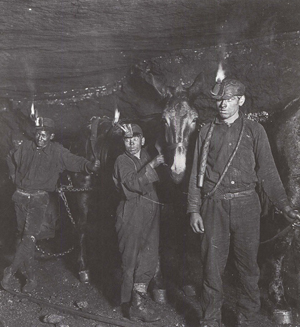




 In her newest title, Boston Tangle: Regency Comes to America, Lown transports three of her English characters from previous books to Boston where they interact with the upper class and, of course, there is a love story—a tangled tale. Lown’s heroine Drusilla Fortesque is a lady who knows her own mind and Lown laces her writing with wry wit and avoids sappiness. Heyer would be proud.