 We (Edith Hope Fine and Judith Josephson) are the Grammar Patrol. Both of us taught for years and are now writers, with thirty plus books between us, including our two popular grammar guides, Nitty-Gritty Grammar and More Nitty-Gritty Grammar. For close to twenty years, we taught writing and grammar basics and now we blog about grammar for writers.
Does your head spin with questions about quotation marks?
• Do commas go inside or outside of quotation marks?
• What about question marks?
• Colons? Semicolons?
• Those pesky dashes and exclamation points?
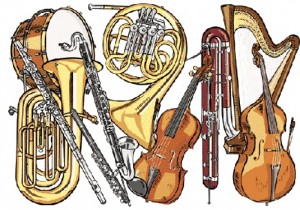 Take a moment to think of soothing music. In a symphony orchestra, some instruments, like second violins and bass violins, are workhorses. They do their jobs and follow the rules. But some all-stars take the spotlight. Oboes sound that pivotal “A” for tuning. Trumpets announce themselves. Ta-da!
The same goes for punctuation marks when used with quotation marks. Some are steady. Some are splashy.
First, we’ll share a grammar rarity: some always rules for periods, commas, colons, and semicolons.
Second, sound the trumpets! Think of question marks, exclamation points, and dashes as the prima donnas. They get special privileges. There’s no always with them.
Here are three cool “Inside/Outside” rules for remembering how punctuation works with quotation marks.
 Let’s face it. Sometimes you just have to memorize the rules. If memorization isn’t your forte (and yes, we still say “fort,” but dink around on the Internet: the two-syllable “for-tay” is on the rise and no longer considered incorrect), we suggest consulting your favorite grammar book. Might we suggest our Nitty-Gritty Grammar or More Nitty-Gritty Grammar. (True confession: We both keep these grammar guides handy, especially for rules surrounding today’s topic.)
 Writing with word processing software gives you more options than the old days of typewriters, but it also gives you gives you more ways to get into trouble. Most of us have twigged to the difference between the typewriter’s straight quotation marks and computer-generated curly ones. You’ll often hear the latter called curly quotes or smart quotes. If Honest Abe is reciting the Gettysburg address, the curly quotation that marks the beginning of his speech, should face the words—they’ll resemble the number 66: “Four score and seven years ago . . .” At the end of his speech, the marks form a 99: “shall not perish from the earth.”